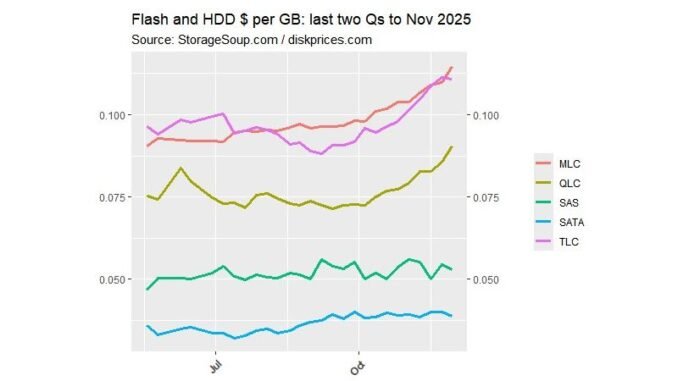
Flash SSD prices jumped sharply this quarter as NAND chip costs surged, driven by AI-fuelled demand and tight supplier control, while HDD prices stayed mostly flat
Flash drive prices shot up over the previous quarter, with industry watchers predicting more rises to come.
That’s mostly driven by increasing NAND chip prices – with contract prices doubling in some cases in November – driven by hyperscaler and enterprise demand against a backdrop of AI workloads.
According to StorageSoup’s own research MLC drive prices went from 9.8c per GB to 11.4c, while TLC drive prices moved from 9.1c per GB to 11c and QLC from 7.2c per GB to 9c.
Meanwhile, spinning disk HDD prices held steady, with SATA drives going from 3.9c per GB to 3.8c per GB while SAS drives went from 5.5c per GB in late September to 5.3c at the end of November.
NAND market analyst Trendforce recently said AI applications and large scale customer orders have fuelled strong demand across all flash drive types; TLC driven by enterprise demand; QLC by increasing demand for capacity-oriented flash, and; MLC, which is strong in industrial control and consumer markets.
The most recent increases – particularly sharp in November – are the latest in upward price movements that have occurred across 2025. To a large extent these are driven by demand, and by AI workloads in particular. But it is also the case that suppliers have controlled supply in an effort to maintain profitability.
In the past two quarters, flash drive prices spent a couple of months fairly flat but then trended upwards sharply around September. Late June prices (MLC 9.2c per GB, TLC 9.9c, QLC 7.4c) were roughly similar to those of September.
Flash prices hit a high in late 2023 and early 2024 when manufacturers slowed production to try to raise prices and boost profitability. SSD prices per GB reached an average of 9.5c per GB in April 2024, which was a rise of 26.67% from autumn 2023.
At the time, many thought SSD prices would achieve even greater highs in 2024, but while production increased, customer demand did not, and prices decreased.
These numbers are from exclusive analysis by StorageSoup that gathers drive prices aggregated weekly by Diskprices.com from Amazon.com. Since March 2023, 135 weeks worth of data and more than 100,000 drive prices and specs have been gathered, with average price per GB calculated every week for TLC, QLC and MLC/unspecified flash drives, as well as SAS and SATA spinning disk.
Diskprices.com aggregates new drive prices that it takes from Amazon.com, with more than up to 1,000 disk prices and specifications processed every week. StorageSoup then filters for flash and spinning disk type, and the average price per gigabyte calculated.
Analysis is based on Amazon.com prices, which are mostly aimed at consumers and SME customers. We use it here as a proxy for drive prices because of the absence of price data from enterprise drive and storage array makers.
Price per gigabyte is a major consideration for customers, but total cost of ownership is probably more important, with purchase cost, energy usage and maintenance costs key.
Data gathered covers drives that range in capacity from less than 1TB up to 30TB for HDDs and up to 12TB for SSDs.
The takeaway
Flash drive prices climbed steeply in recent months, with NAND contract prices in some cases doubling in November. StorageSoup’s long-running analysis shows MLC, TLC, and QLC SSDs all rising in price per gigabyte, fuelled by heavy hyperscaler and enterprise demand tied to AI workloads.
While demand pressure is the main driver, suppliers have also tightened output to boost profitability, echoing the price spike cycle seen in late 2023 and early 2024. HDDs, by contrast, remain largely stable.
The dataset, covering more than 100,000 Amazon-sourced drive listings over 135 weeks, underscores a market where rising SSD costs are reshaping storage economics—making TCO, not just price per gigabyte, a critical consideration for buyers.
Read more about storage media
Solidigm: NAND demand soars as cloud providers underestimate AI inferencing. Cloud and enterprise AI workloads are generating far more inference data than expected, driving a sudden spike in NAND demand, flash prices, and pressure on AI project ROI.
Flash vs HDD: Pros and cons, and the workloads they suit best. Flash storage is reshaping enterprise IT with QLC and NVMe innovations, but HDD still dominates on cost. Explore flash vs HDD, cloud storage, and the future of all-flash datacentres.